PILOT — Private preview. Progress is saved for this browser session only.
HaiPhai.AI Fluency for Biotech
Operational Intelligence · Built for Biotech Leadership

Your science is ready.
Your timelines aren't.

Biotech companies don't lose races on the science. They lose them on the operational overhead that extends timelines, burns runway, and delays the valuation inflection points your investors and board are waiting for. HaiPhai identifies where your organization is losing time — and builds the systems to take it back.

12–18
Months of operational time typically recoverable on the path to approval
0.5 FTE
Reclaimed per 50-person team from high-volume, low-judgment work
74
Purpose-built agents across every biotech function
21
Curriculum modules across all tracks
~25h
Of guided content
See what we'd fix →Read the curriculum

The timeline is the business

Every month of delay costs more than your team realizes

A 50-person biotech burns $2–5M per month. Operational inefficiencies that extend regulatory timelines, slow clinical site activation, or miss grant windows don't just waste time — they consume runway that could fund the next data readout.

Every delay pushes back a valuation inflection point

Phase 2 readouts, NDA filings, first approvals — these are the moments that multiply your company's value and unlock better financing terms. Six months of operational drag is six months before that inflection point arrives. The science isn't causing the delay. The operations are.

The bottlenecks are predictable and solvable

Regulatory drafting. Clinical site communications. Contract routing. Grant research. The same functions bleed time at every biotech. The companies that move fastest aren't smarter — they've eliminated the operational tax on their scientific talent.

We start with your goals, not our technology

HaiPhai is not a software company that sells you AI tools and walks away. We're an operational partner that starts where strategy lives — at the outcomes you need to reach and the timeline you need to hit — then works backwards to find where technology closes the gap.

01 — Understand your goals

Where do you need to be?

We map your 12, 24, and 36-month milestones — the readouts, filings, and financing events that define success for your board and investors. This is the fixed point everything else is measured against.

02 — Map the bottlenecks

Where is time being lost?

We identify exactly where your team is spending hours on work that doesn't advance those goals. Usually it's regulatory, clinical ops, and G&A — and it's almost always measurable in days and dollars once you know where to look.

03 — Build the right solutions

AI where it earns its place

Sometimes the fix is process redesign. Sometimes it's purpose-built AI agents. Usually both. We build what actually moves your timeline, not what's easiest to demo. Then we train your team to run it without us.

All curriculum tracks

0 / 86 lessons complete
Module 01

The AI-Compressible Biotech

Where your timelines actually live, how to find your organization's highest-leverage AI opportunities, and how to measure compression in outcomes that matter.

~60 minRequired
Module 02

NDA in a Week

Why regulatory dossiers take 6 months and don't have to. Parallel architecture, AI-assisted drafting, and human review workflows that collapse timelines without sacrificing quality.

~75 minRequired
Module 03

Global Filings in Days

Single-dossier architecture for multi-jurisdiction submissions. Regulatory localization at scale across ICH regions, languages, and format requirements.

~60 minRequired
Module 04

Trial Design and Accrual at Scale

Why 40% of trials miss enrollment targets and how to fix it. AI-assisted protocol design, site selection intelligence, patient identification, and accrual monitoring.

~75 minRequired
Module 05

From 1,000 Molecules to the Next Candidate

How to use AI to compress the drug discovery cycle. SAR at scale, pharmacophore analysis, generative molecular design, and ADMET-first filtering.

~60 minRequired
Module 06

Ops at the Speed of Science

Eliminating the G&A tax. Contract automation, grant intelligence, and building an AI-first back office that stops slowing the science.

~60 minRequired
Module 07

Cross-Functional AI Coordination

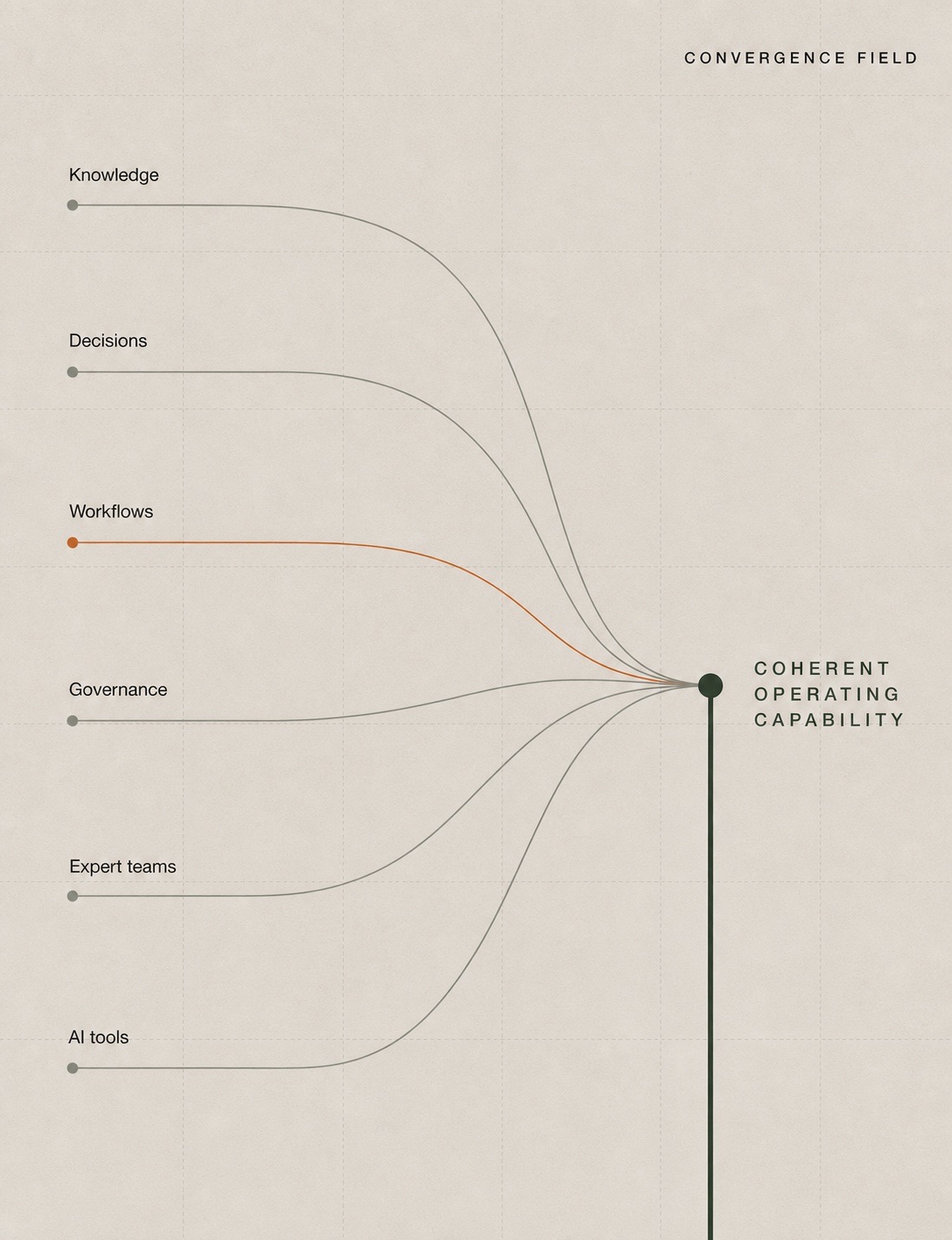
Why individual AI tools don't compound. Workflow redesign, institutional memory, and the governance structures that turn individual capability into organizational advantage.

~60 minRequired
Module 08

Prompting for Biotech Outcomes

Context as a force multiplier. Patterns for scientific documents, regulated environment constraints, chain-of-thought for complex work, and building a team prompt library.

~60 minRequired
Module 09

AI Governance for Biotech

What data you can and can't use, how to build a policy that enables instead of blocks, validation and audit trail requirements, and a 90-day governance roadmap.

~60 minRequired
Module 10Claude

How Claude Works — Mental Models & Limits

What Claude actually is, how the context window shapes every interaction, when to trust vs. verify outputs, and what data never belongs in any AI tool.

~72 minRequired
Module 11Claude

Setting Up Claude Code & Claude Chat

Account setup, plan tiers, installing the Claude Code CLI, IDE integration, writing your first CLAUDE.md, and configuring Claude.ai Projects for your team.

~95 minRequired
Module 12Claude

Prompting Claude Well

The anatomy of a high-performance prompt, the four pillars of effective instructions, iterative refinement, building a shared prompt library, and diagnosing failure modes.

~88 minRequired
Module 13Claude

Code Coworking with Claude Code

The pair-programming mindset, reading unfamiliar codebases, debugging workflows, refactoring and test generation, safe agentic tasks, and extending Claude Code with hooks and MCP servers.

~110 minRole Path
Module 14Claude

Chat Workflows for Knowledge Work

Document drafting and editing loops, research synthesis, data analysis with artifacts, meeting prep and async comms, and using Projects for persistent team memory.

~90 minRole Path
Module 15Claude

Team Conventions & Continuous Improvement

Establishing shared CLAUDE.md conventions, reviewing AI-generated work, onboarding new members, measuring impact, and running retrospectives for your AI practices.

~85 minRequired
Module 16Yungsten

The Yungsten Method — Prototype to Production

How Yungsten turns fragile AI prototypes into systems teams can actually run. Covers our production standard, client intake process, the 90-day engagement arc, and what 'done' means on a Yungsten project.

~72 minRequired
Module 17Yungsten

Building Named Agents with Claude Desktop

End-to-end process for designing, configuring, testing, and handing off named AI agents using Claude Desktop, MCP servers, and system prompts. Four agents per quarter, starting here.

~88 minRequired
Module 18Yungsten

Client Wiki Systems — Obsidian & CLAUDE.md

How to architect, populate, and maintain an executive AI wiki in Obsidian. Writing CLAUDE.md files that teach Claude about a client's organization. Wiki governance and the quiet-tending practice between visits.

~54 minRequired
Module 19Yungsten

Facilitating Client AI Sessions

Running effective executive AI sessions and monthly team seminars. Teaching clients to prompt well, handling resistance, and building the internal fluency that makes Yungsten engagements stick after we leave.

~54 minRequired
Module 20Yungsten

Production Engineering for Agentic Systems

For implementation engineers: production deployment patterns, error handling in agentic workflows, tool failure recovery, and the technical handoff documentation standards that make client systems maintainable at scale.

~54 minRequired
Module 21Yungsten

Yungsten Track Capstone — End-to-End Engagement Simulation

A single 90-minute scenario-based challenge covering the complete Yungsten workflow: intake brief, engagement scoping, agent specification, system prompt, MCP configuration, test plan, operator runbook, wiki entry, CLAUDE.md, and architecture document. Demonstrates mastery of Modules 15–19.

~90 minRequired